Posts

The Cheviot, the Stag and the Black, Black Oil, 6 June, 1974

Image
Zoë:  The Cheviot, the Stag and the Black, Black Oil is, according to the information accompanying the film on YouTube,a play written in the 1970s by Merseyside-born playwright John McGrath. From April 1973, beginning at Aberdeen Arts Centre, it was performed in a touring production in community centres in Scotland by 7:84 and other community theatre groups. The television version, directed by John Mackenzie was broadcast on 6 June 1974 by the BBC as part of the Play for Today series. The play seems to me to be the nearest you can get on telly to "promenade theatre". The one and only thing I like about promenade theatre is that you get a bit of exercise as you have to move about a building, rather than sitting in a seat in the stalls. Of course, when watching such a thing on television this is no longer the case. Instead of you wandering about, the production does the wandering for you, jumping between the interior of Dornie village hall - complete with rather bemused, mostly...

Our Day Out, by Willy Russell - broadcast December 28th, 1977.

Image
    The Wikipedia entry for this play baldly states that " Our Day Out is about poor children from Liverpool, England", which makes it sound rather solemn. Indeed, if the entry had added that the children in question were all in a remedial class at their local school, that would have compounded the impression. However, this is one of the most joyous, life-giving pieces of television drama that I have seen. I suppose I shouldn't have been surprised, as Willy Russell also gave us Educating Rita.   Shot entirely on film, the play begins in a street that looks as if bailiffs have removed everything of value, including the trees. It is the bleak, post-industrial landscape that will later feature in Alan Bleasdale's Boys From the Blackstuff. A small girl in school uniform is stopped from crossing the road by an elderly lollipop man and she explains that she's in a hurry because her class is going on a school trip. "Where are you going today?"   "It'...

The Billy Trilogy

Image
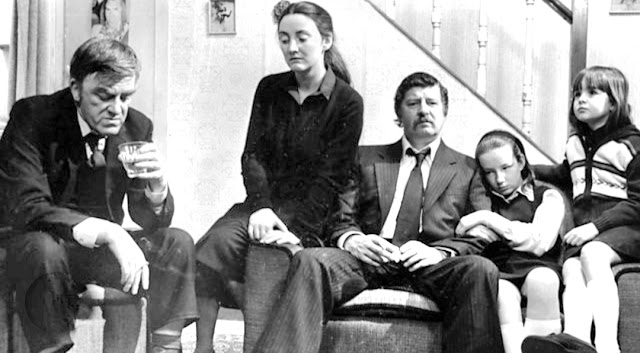
When Phil told me we'd be watching the trilogy of plays that launched the career of Kenneth Branagh, I was excited, as I'm a fan of Branagh. Some twenty minutes into the first of the three plays, I began to have severe doubts. However, by the end of the trilogy, I decided it was a triumph, while at the same time having been bored stiff quite a lot of the time and finding large chunks of it melodramatic and quite unpleasant. It is the great mystery of theatre that things that are a bit of an endurance test can also be things you do not regret having seen. The three plays are all set in Belfast in the late 1970s. As the first and second open, this is explained on the screen, the "1970s" acquiring an apostrophe in the second one, while the playwright's name, Graham Reid, sheds an initial "J." between Play One and Play Two. Most of the action takes place in the tiny front room of a small terrace house, where the Martin family - Norman, the father, and Billy,...

Kate the Good Neighbour - broadcast 6 March, 1980

Image
Zoë: Kate the Good Neighbour  opens with a series of vignettes of Kate, a tweed-suited elderly woman, as she goes about her neighbourhood, setting various members of her local community to rights. First, a greengrocer who runs a stall in the local market, (this is not yet the world of big supermarkets), is verbally rapped over the knuckles for trying to flog bad tomatoes. Then Kate goes to “help” a recently widowed woman, played by Dandy Nicholls - unforgettable from her earlier role as Else Garnett, aka “the silly old moo”, (especially memorable for me is the episode where, after the Garnetts have the telephone installed, Else sits quietly in the background, steadily reading her way through what look like rather large volumes - which you realise at last, when she exclaims, “Ooh, you’ll never guess who’s in here", are the newly delivered London telephone directories). Kate chivvies Dandy Nichols’ character into crushing her foolish sentimentality, (as Kate sees it), and ridding he...

Under the Hammer by Stephen Fagan, broadcast 1984

Image
Zoë: I loved this play. It is set in a very superior English auction house as a pre-sale paintings exhibition is being readied for public view. The credits roll to the sound of an auctioneer calmly accepting bids in the hundreds of thousands. This soundtrack fades as the opening scene is revealed - porters in dust coats setting up partitions and hanging pictures, while suave, suited men stroll about, discreetly overseeing things.  Peter Vaughan, the man who is clearly the senior porter climbs down from a step ladder and announces it is time for a tea break. All the porters down tools and we head with them below stairs. Peter Vaughan's character, Les Stone, acts as mother, pouring milk into everyone's mugs of tea and handing them around. After a discussion about the technicalities of lighting and the unreliability of the electricians with whom the porters work, Les reveals that the Princess of Wales will be visiting tomorrow. This news is received with excitement by almost all t...

The Fishing Party, by Peter Terson, broadcast June 1st 1970

Image
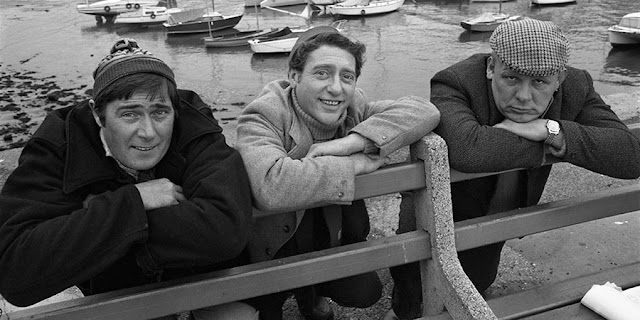
  "You 'aven't got any mates? I couldn't live without mates!" Phil - Shot entirely on film, The Fishing Party is a gentle comedy about a trio of middle-aged Yorkshire miners going on a fishing trip to Whitby, where they have to contend with seasickness and the appalling snobbery of a guesthouse landlady, reluctantly aided by her henpecked husband. It begins with a cheerful brass band theme written by composer Sidney Sager (fondly remembered for his excellent score for Children of the Stones ), just to confirm that the viewer knows that we are in the North. The three miners, Art (Brian Glover), Abe (Douglas Livingstone) and Ern (Ray Mort) begin their visit with a mug of tea at a seafront stall, where the stallholder warns them that the holiday season is over. The miners seem offended that he has taken them for "trippers" rather than serious fishermen and there is an exchange where the dialogue felt a little too contrived. Fortunately, the play soon find...

Play for Today No. 1 - The Long Distance Piano Player, by Alan Sharp, broadcast October 15, 1970

Image
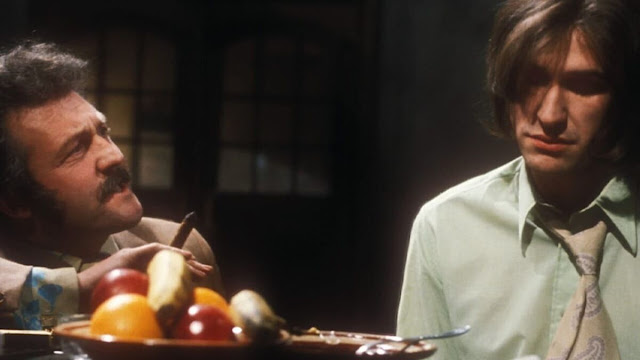
Zoë: As a lifelong fan of Ray Davies I was thrilled when Phil B suggested that we start this blog by watching the first ever Play for Today, which starred arguably the most famous member of the Kinks. The play was broadcast in October 1970 which I think means Davies must have been about 26 years old at the time that it was made. I am sorry to say that, after witnessing his performance, albeit through the smudgy lens of decaying video imagery, I understand why he did not go on to take the world of cinema by storm. I wonder if Alan Sharp, the author of The Long Distance Piano Player was inspired by They Shoot Horses Don’t They , which came out the year before and concerns a dance marathon and anomie. Perhaps for him it seemed perfectly reasonable to substitute a rainy northern English town for Santa Monica and a single piano player (Davies) for a varying cast of characters. Or possibly he was inspired by Alan Sillitoe's The Loneliness of the Long Distance Runner , which came out in ...